
Symptom Guide · Rich Running Diagnosis

Black Smoke
from Exhaust

💨
White / Grey
Coolant burning · head gasket · intake gasket
💙
Blue / Grey
Oil burning · valve seals · piston rings · turbo seals
🖤
Black ← You Are Here
Running rich · excess fuel · clogged air filter · MAF · injector leak · turbo seal

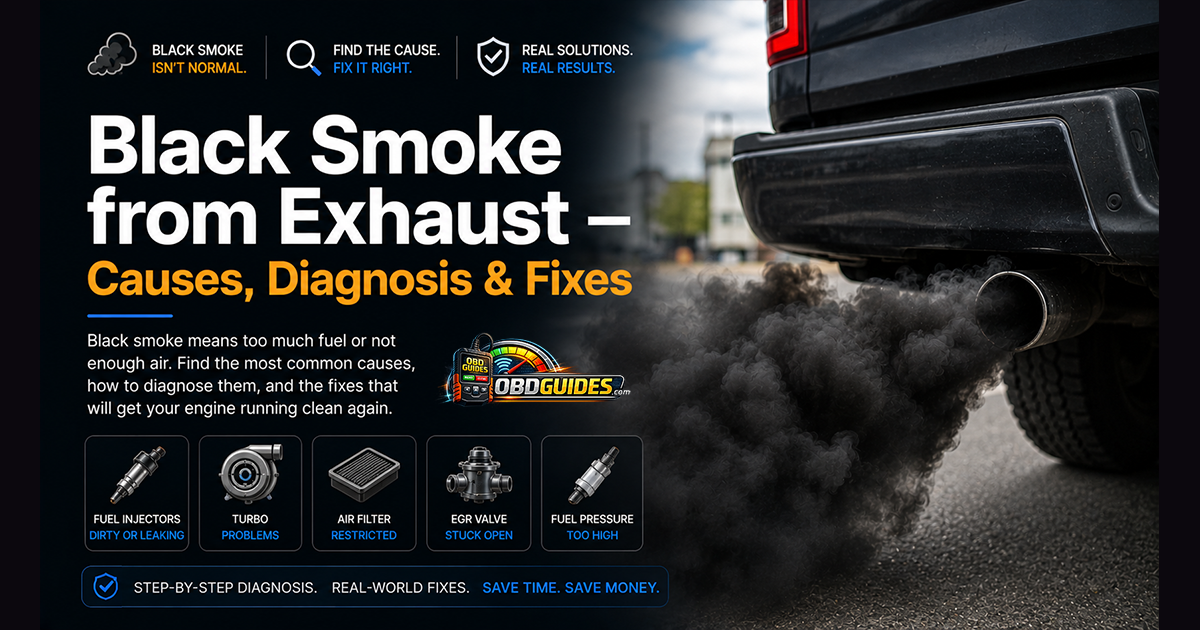
Black exhaust smoke means the engine is burning too much fuel relative to air — a rich running condition. Every cause of black smoke produces unburned hydrocarbons that foul the catalytic converter, reduce MPG significantly, and indicate wasted fuel. Most causes are inexpensive to fix.

⚠️ Damages catalytic converter over time
⛽ Significant MPG loss — costs money daily
🔧 Many causes under $30 DIY
🚗 Petrol and diesel vehicles
// 01 — Immediate Decision

Drive or Park?

🖤

Usually driveable short-term — but causing ongoing damage

// Drive to Shop — Diagnose Soon

Black smoke only under hard acceleration — clears at cruise
Diesel black smoke on cold start that clears when warm
CEL is solid (not flashing), running otherwise normally
Smoke is light — occasional puff, not a constant cloud
No temperature rise, no unusual noises

// Act Promptly — Elevated Risk

Constant thick black smoke at idle — not just under acceleration
Strong fuel smell inside the cabin or near the exhaust
CEL is flashing — misfire alongside rich running
Spark plug is visibly oil-wet or fuel-fouled
Smoke getting progressively worse week by week
Catalytic converter damage warning: Running consistently rich sends unburned fuel vapour through the catalytic converter on every exhaust stroke. The excess hydrocarbons burn inside the converter at extreme temperatures — the same mechanism that destroys converters during misfire events. Prolonged rich running from any cause will eventually require a converter replacement on top of the original fault repair.
// 02 — Petrol vs Diesel Black Smoke

Petrol vs Diesel — Different Causes, Same Symptom

Black smoke from a petrol (gasoline) engine and black smoke from a diesel engine share the same meaning — too much fuel — but the specific causes differ significantly between the two fuel types.

⛽ Petrol (Gasoline) Engines

Clogged air filter starving engine of air
Dirty or failing MAF sensor under-reporting airflow
Leaking fuel injector dribbling excess fuel
Failed upstream O2 sensor — PCM running open-loop rich
High fuel pressure from a stuck fuel pressure regulator
Turbo seal failure — oil burning alongside rich condition

🔵 Diesel Engines

Clogged air filter or restricted intake (most common)
Faulty injector — stuck open, wrong spray pattern
Turbocharger failure — insufficient boost for fuel delivery
EGR valve stuck open — diluting intake charge
Excessive fuelling from ECM fault or tuning
DPF (diesel particulate filter) regen issue
Diesel important distinction: Some black smoke from a diesel on cold start or under sudden heavy load is normal — diesels run rich during cold starts and when boost hasn’t built yet. Persistent black smoke at cruise or at warm idle is always a fault. If the smoke clears after the first minute of driving and only appears again under hard acceleration, the engine may be within normal diesel operation.
// 03 — Pattern Identification

When Does the Black Smoke Appear? — This Identifies the Source

Black Smoke Pattern → Most Likely Cause

Note precisely when the smoke appears and whether it’s constant or intermittent.

Only under hard acceleration
Clogged air filter or MAF fault — enrichment spike. Under hard acceleration, the PCM commands a significant fuel enrichment pulse. If the air filter is restricting airflow, the engine can’t pull enough air to combust the extra fuel — the excess exits as black smoke. A dirty MAF that under-reports airflow causes the PCM to deliver fuel calculated for less air than is actually entering — the surplus unburned fuel appears as black smoke under the high-demand conditions of full-throttle acceleration.
Constant black smoke at idle
Leaking fuel injector or failed O2 sensor — constant rich condition. A leaking injector continuously dribbles fuel into its cylinder even when not commanded — the cylinder runs chronically rich and exhausts black smoke on every stroke. A failed upstream O2 sensor that’s stuck reporting a lean reading causes the PCM to add fuel continuously to correct for the false lean signal — the engine runs rich at all operating conditions. Both produce the most fuel-saturated plugs you’ll encounter — black, wet, with strong fuel odour.
Black smoke on cold start, clears when warm (diesel)
Normal diesel cold-start enrichment — or faulty glow plugs. Diesel engines inject extra fuel on cold starts because diesel doesn’t ignite as readily when cold. This typically produces light black or grey smoke for the first 30–60 seconds. If it persists beyond 2 minutes or is heavy/dense, a faulty glow plug is failing to pre-heat the combustion chamber — the fuel isn’t igniting cleanly and the excess exits as black smoke. Test each glow plug for correct resistance and current draw.
Black smoke under load — diesel
Turbocharger failure or restricted air intake. Diesel engines rely on turbocharger boost to supply enough air for the injected fuel volume at load. A failing turbo that can’t build adequate boost leaves excess fuel with insufficient air — the unburned fuel exits as heavy black smoke under load. Alternatively, a clogged air filter on a diesel is more serious than on a petrol engine because the diesel injects fuel proportional to boost — restricted air means the fuel-to-air ratio is severely rich at high load.
Intermittent puffs — one cylinder
Single leaking injector. A puffing pattern where visible black smoke appears at a regular interval — one puff every few engine revolutions — suggests one cylinder is intermittently over-fuelling. A partially stuck-open or dripping injector delivers extra fuel on the injection event, which exits as a discrete puff rather than constant smoke. The puff rate relates directly to engine RPM. A cylinder-specific misfire code may also be stored from the rich combustion disruption.
Black smoke + strong fuel smell from exhaust
Severely rich condition — fuel pressure regulator or multiple leaking injectors. A strong fuel smell from the exhaust pipe alongside black smoke indicates a substantial amount of unburned fuel is passing through the exhaust. A stuck-open fuel pressure regulator raises system fuel pressure above spec, causing all injectors to over-deliver simultaneously. Multiple injectors leaking — from age, heat, or contaminated fuel — produce the same effect. The catalytic converter is being rapidly fouled by the excess fuel loading.
// 04 — Causes Ranked by Likelihood

6 Causes of Black Exhaust Smoke — Ranked

These are ranked for petrol (gasoline) engines. For diesel engines, air filter and turbocharger causes are typically more prominent — see the diesel notes in section 02 and vehicle-specific notes in section 07.

1
Clogged Air Filter
Very Common — and free to check
A severely restricted air filter is the single most common cause of black exhaust smoke and is also the cheapest to fix. When the air filter is blocked, the engine can’t pull enough air to mix with the fuel being injected — the resulting rich mixture burns incompletely and exits as black carbon-laden smoke. The effect is most visible under hard acceleration when fuel demand peaks. A quick visual check resolves the diagnosis: hold the air filter up to light — if you can’t see light through it, replace it. Air filters cost $15–$30 and take 5 minutes to swap. Always check this first before any other diagnosis of black smoke.
OBD Codes
P0172 · P0175 (rich)
Quick Check
Hold filter to light — if no light visible, replace immediately. $15–$30, 5 min.
DIY Cost
$15–$30
2
Dirty or Failing MAF Sensor
Very Common
A MAF sensor contaminated with oil vapour can both over-report and under-report actual airflow depending on the nature of the contamination. When a contaminated MAF over-reports airflow, the PCM delivers more fuel than the actual air mass can combust — producing a rich condition and black smoke. This can result from an over-oiled performance air filter (K&N, Spectre, etc.) that coats the MAF wire with filter oil. Cleaning the MAF with dedicated MAF cleaner spray is the $8 diagnosis and fix — if black smoke reduces or disappears after cleaning, the MAF was the cause. If the MAF is reporting significantly outside its expected range, P0101, P0172, or P0175 codes will typically be stored.
OBD Codes
P0101 · P0172 · P0175
Quick Check
Clean MAF with MAF cleaner — $8, 10 min. If smoke reduces, MAF was cause.
DIY Cost
$8 to clean · $80–$300 to replace
3
Failed Upstream O2 Sensor — PCM Running Open-Loop Rich
Common
The upstream oxygen sensor is the PCM’s primary feedback device for maintaining the correct air/fuel ratio in closed-loop operation. When the upstream O2 sensor fails with a stuck-lean reading (reporting that the mixture is lean when it isn’t), the PCM continuously adds fuel in an attempt to correct for the false lean signal — the engine runs progressively rich, eventually producing black smoke and heavily fuel-fouled plugs. The diagnostic signature is an O2 sensor voltage that’s stuck low (below 0.3V) when the engine should be in closed-loop, or a P0132 (O2 high voltage) indicating the sensor itself is reporting rich without the engine actually being that rich. Monitor O2 voltage switching on a scanner to confirm.
OBD Codes
P0131 · P0132 · P0172
Quick Check
Scanner: upstream O2 voltage stuck lean or not switching — replace sensor
DIY Cost
$20–$80 sensor · 20–30 min
4
Leaking Fuel Injector(s)
Common
A fuel injector that leaks — either through a deteriorated O-ring seal or a stuck-open needle valve — delivers fuel into its cylinder continuously rather than only during the commanded injection pulse. The excess fuel richens that cylinder’s mixture, produces a fuel-fouled plug, causes a mild misfire or rough idle, and contributes to black smoke. A single leaking injector typically produces a rhythmic puff pattern rather than constant smoke. The diagnostic test: after a hot soak with the engine off, crank briefly and remove the spark plug on the suspect cylinder — a wet, fuel-smelling plug confirms injector leakage into that cylinder while the engine was off. Running injector tests with a bidirectional scanner can also isolate a specific injector.
OBD Codes
P0172 · P030x · P020x
Quick Check
Pull plug after hot soak — fuel-wet plug = leaking injector above that cylinder
DIY Cost
$80–$150 off-car cleaning service · $150–$400 replacement
5
High Fuel Pressure — Stuck Fuel Pressure Regulator
Moderate
The fuel pressure regulator maintains system fuel pressure at the correct level — typically 35–65 PSI depending on vehicle. When the regulator’s diaphragm fails or the valve sticks open, fuel pressure rises above spec — all injectors deliver more fuel per pulse than calculated by the PCM, because the PCM calculates injection based on normal pressure but the higher pressure forces more fuel through. The result is a system-wide rich condition producing black smoke, fuel-fouled plugs across all cylinders, and poor fuel economy. Unlike a leaking injector (which affects one cylinder), a failed pressure regulator produces consistent rich running across all cylinders simultaneously.
OBD Codes
P0172 · P0175 · P0190
Quick Check
Fuel pressure test — above spec at idle. All plugs equally fouled.
DIY Cost
$20–$80 regulator · 20–45 min
6
Turbocharger Seal Failure — Oil Burning as Black Smoke
Less Common — turbocharged vehicles
On turbocharged engines, a failed compressor-side turbo seal allows oil from the turbo bearing to be ingested into the intake along with the boost charge. This oil burns in the combustion chamber and exits as black or blue-black smoke — the colour depends on the ratio of oil to fuel. The distinctive signs: a faint bluish tinge to what appears to be black smoke, excessive oil consumption without visible external leaks, and a turbine wheel coated in oily carbon deposits. A characteristic acrid, burning-oil smell accompanies the smoke. This diagnosis requires inspecting the intake side of the turbocharger for oil deposits — if the compressor housing is coated in oil, the seal has failed.
OBD Codes
P0299 · P0172 (with blue tinge)
Quick Check
Inspect turbo compressor inlet for oil — coated housing = seal failure
Cost
$400–$1,200 reman turbo · $1,500–$4,000 shop installed
// 05 — First Checks Without a Scanner

What to Check First — In Order

1
Check and replace the air filter — always first
Pull the air filter from its housing and hold it up to a light source. If you cannot see light through it, this is almost certainly contributing to or causing the black smoke. Replace immediately — this is the cheapest, fastest, most commonly overlooked cause of black exhaust smoke. While the filter housing is open, inspect the MAF sensor and the housing interior for oil contamination from an over-oiled performance filter.
No tools · $15–$30 · 5 min
2
Clean the MAF sensor
Immediately after replacing the air filter, clean the MAF sensor with dedicated MAF cleaner spray. An over-oiled filter may have already coated the MAF wire — cleaning it takes 10 minutes and $8 and will reduce or eliminate black smoke if MAF contamination was the cause. Spray 10–15 bursts onto the sensing wire, allow 10 minutes to dry, then test drive. Do not use carb cleaner, brake cleaner, or compressed air on the MAF sensing wire — these damage the element.
MAF cleaner · $8 · 10 min
3
Inspect spark plugs for fouling type
Remove and inspect the spark plugs. Dry black carbon deposits across all plugs = rich condition across all cylinders (MAF, O2 sensor, high fuel pressure). Wet, oily, fuel-smelling plug on one cylinder = leaking injector on that cylinder. Black deposits only on some plugs = misfiring cylinders not combusting their fuel charge properly. The fouling pattern tells you whether the cause is system-wide or cylinder-specific before you do any further testing.
Plug socket + ratchet
4
Check for fuel smell at the exhaust tip
With the engine warm, carefully smell the exhaust output. A distinct raw fuel smell from the exhaust (beyond normal exhaust odour) confirms significant unburned fuel is passing through the system — consistent with a leaking injector, stuck-open pressure regulator, or failed O2 sensor causing severe over-fuelling. A faint smell is normal; a strong petrol/diesel smell is not. Also check the interior of the exhaust pipe for heavy, wet, black soot deposits — these indicate consistent rich running.
Observation · careful — pipe is hot
5
Inspect the turbo compressor inlet (turbo vehicles)
On turbocharged vehicles: disconnect the air intake hose at the turbo compressor inlet and shine a light inside. A clean, dry housing is normal. An oily, wet, or carbon-coated compressor housing confirms oil is entering the intake from a failed compressor-side seal — the oil is being burned in the engine and contributing to the black/blue-black smoke. Also check the intercooler outlet — pooled oil there confirms the same fault.
Flashlight (turbo vehicles only)
6
Check LTFT — is the PCM trying to correct rich?
With a scanner: look at long-term fuel trim (LTFT) at idle. A negative LTFT (e.g. -8% to -20%) means the PCM is trying to reduce fuel delivery to correct for a rich condition — the black smoke is confirmed as a rich running fault, and the PCM knows it. A LTFT near zero with black smoke suggests the PCM can’t detect the rich condition (possible failed O2 sensor giving incorrect feedback) or the rich condition is bypassing the closed-loop system (fuel pressure issue, injector leaking physically bypassing PCM control).
Scanner required
Correct sequence: 1) Replace air filter ($15–$30). 2) Clean MAF ($8). 3) Inspect all plugs for fouling pattern. 4) Smell exhaust for raw fuel. If all clear and smoke persists — scan for O2 sensor codes and check LTFT. Negative LTFT = the PCM is fighting a rich condition caused by fuel pressure, injector, or failed O2 sensor.
// 07 — Vehicle-Specific Notes

Black Smoke — Most Common Causes by Make

Toyota (Camry, RAV4, Tacoma)
2AZ-FE: MAF contamination from PCV oil vapour is the primary cause of black smoke on acceleration — clean MAF first. 1GR-FE V6: over-oiled performance filters a frequent cause. Tacoma diesel markets: DPF regen issues causing temporary black smoke bursts. Code: P0172 · P0101.
Ford (F-150, Explorer, Ranger)
6.0L/6.4L Power Stroke diesel: injector failures causing black smoke under load — common fault on these engines. 3.5L/2.7L EcoBoost: turbo seal failures at 100k+ causing oil ingestion and black-blue smoke. 5.0L Coyote: fuel pressure regulator failures at high mileage. Code: P0172 · P0299.
Chevy/GM (Silverado, Equinox, Duramax)
6.6L Duramax diesel: injector issues and EGR system failures cause black smoke — known failure points at 200k. 5.3L V8 petrol: air filter and MAF contamination from over-oiled filters common. 2.0T: turbo seal failures causing oil ingestion. Code: P0172 · P0299.
BMW (3/5-Series, X3/X5)
N54/N55: valve cover gasket failure allows oil into intake causing black-blue smoke — inspect PCV system and breather hoses. N20: turbo seal failures at 80–100k miles causing oil consumption and smoke. Diesel (M57/N57): injector wear causing black smoke under load at 150k+. Code: P0172 · P0299.
Volkswagen/Audi (Golf, Jetta, A4)
2.0T TSI (EA888): PCV system failures causing oil consumption and blue-black smoke — a well-documented fault. DPF failures on diesel models (TDI) causing black soot discharge. Injector failures on high-mileage TDI engines. Code: P0172 · P2187.
Dodge/Ram (Ram 1500, Cummins)
6.7L Cummins diesel: normal black smoke puff under hard acceleration is common — turbo spools slightly behind demand. Persistent smoke: EGR cooler and EGR valve issues. 5.7L Hemi petrol: fuel injector o-ring failures causing rich running at high mileage. Code: P0172 · P0401.
🤖

Black Smoke on Your Specific Vehicle?

Tell our free AI Diagnostic tool your make, model, year, whether petrol or diesel, and exactly when the smoke appears — it will identify the most likely cause and the correct first test.

⚡ Free AI Diagnostic
// 08 — How to Fix + Cost Estimates

Black Smoke Fixes — Cost and DIY Difficulty

FixDIY CostShop CostDIY?
Air filter replacement$15–$30$30–$80Yes — 5 min
MAF sensor cleaning$8$80–$150Yes — 10 min
Spark plug set (if fouled)$30–$120$150–$400Yes — 30–90 min
Upstream O2 sensor$20–$80$120–$280Yes — 20–30 min
MAF sensor replacement$60–$250$150–$350Yes — 15 min
Fuel pressure regulator$20–$80$100–$250Yes — 20–45 min
Fuel injector off-car cleaning$80–$150$150–$350Moderate
Fuel injector replacement (each)$50–$200$150–$400Moderate
DPF cleaning/replacement (diesel)$200–$600$600–$3,000Moderate
Catalytic converter (if damaged)$150–$600$500–$2,500Moderate
Turbocharger replacement$400–$1,200 reman$1,500–$4,000Shop recommended
Correct order: 1) Replace air filter ($15–$30). 2) Clean MAF ($8). 3) Inspect all plugs — note fouling pattern. 4) Check LTFT on scanner. 5) If LTFT negative (PCM fighting rich) — test fuel pressure and O2 sensor voltage switching. If LTFT near zero with black smoke — check O2 sensor for stuck reading and inspect turbo inlet for oil (turbo vehicles).
// 09 — FAQs

Frequently Asked Questions

Some black smoke under sudden hard acceleration is normal on diesel engines — when the driver demands sudden full throttle, the injectors deliver a large fuel charge before the turbocharger has built adequate boost pressure to provide matching air. This brief rich condition produces a puff of black smoke that clears as boost catches up, typically within 1–2 seconds. Cold starts also produce lighter black or grey smoke for the first 30–60 seconds. Persistent black smoke at cruise speed, at warm idle, or sustained for more than a few seconds under load is always a fault requiring investigation.
Yes — and it does so progressively. Unburned hydrocarbons that produce black smoke also pass through the catalytic converter. The converter attempts to oxidise these hydrocarbons at its operating temperature, but under sustained rich conditions it cannot process the volume — the excess hydrocarbons ignite inside the converter substrate, raising internal temperatures far above design limits. This destroys the precious metal washcoat and eventually melts the ceramic substrate — the same mechanism as a misfire event but slower. Prolonged black smoke from a rich condition often results in a P0420 and the need for converter replacement in addition to fixing the original fault.
A near-zero LTFT with black smoke means one of two things: either the PCM doesn’t know the mixture is rich (its O2 sensor feedback is telling it the mixture is correct when it isn’t — possible failed O2 sensor sending a false lean signal that the PCM is correcting for), or the rich condition is bypassing PCM control entirely (a physically leaking injector delivers fuel that the PCM never commanded, so the fuel trim system can’t compensate). Check upstream O2 sensor voltage switching on a scanner and inspect plugs for individual cylinder fouling to distinguish between these two scenarios.
Clean the MAF sensor next — if the previous filter was over-oiled, the MAF may be contaminated. Then inspect all spark plugs for their fouling pattern: dry carbon on all plugs = system-wide rich (check O2 sensor, fuel pressure); wet fuel-smelling plug on one cylinder = leaking injector on that cylinder. If plugs look normal, put a scanner on the vehicle and check LTFT and upstream O2 voltage switching. A lazy or stuck O2 sensor is the most common cause of continued rich running after the air filter has been ruled out.
No — switching fuel grades does not cause black smoke. Higher octane fuel burns differently (more resistance to pre-ignition) but doesn’t alter the air/fuel ratio that the PCM controls. If black smoke appeared after a fuel fill-up, consider whether the fuel quality itself was poor (contaminated or water-diluted fuel) rather than the octane grade. Contaminated or water-diluted fuel can cause misfires and rough running that produce incomplete combustion byproducts, but this resolves once the bad fuel has been consumed and the tank filled with clean fuel.
// Found this useful? Share it