
Symptom Guide · No Scanner Required

Rough Idle Only
When Warm

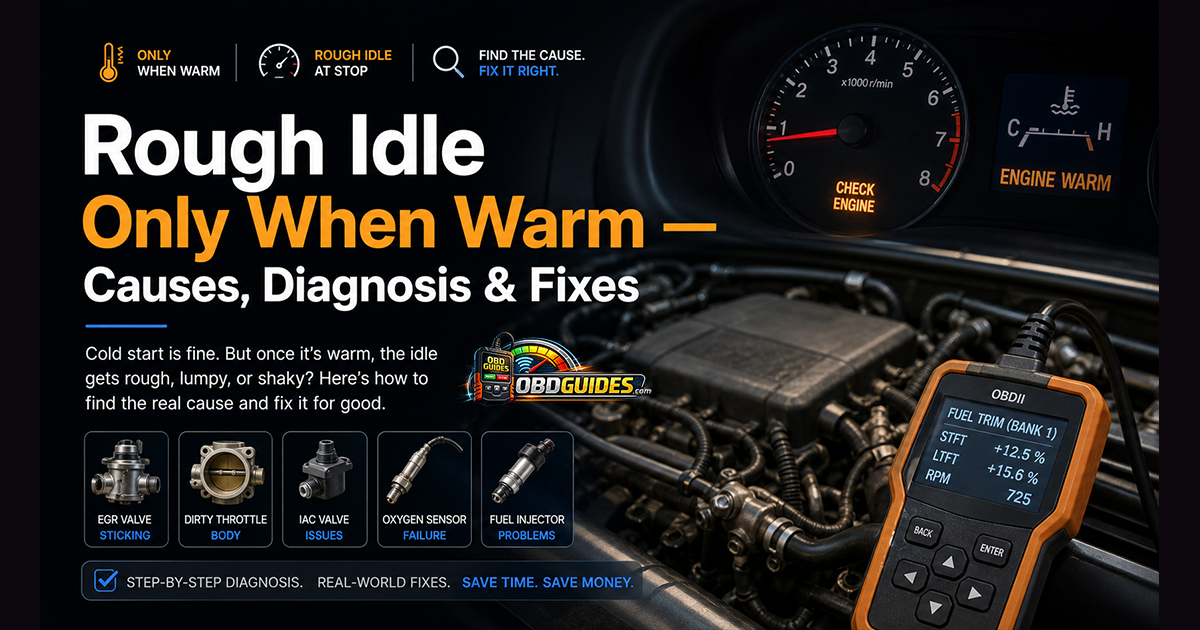
The engine starts clean, idles smoothly when cold, then develops a rough or hunting idle after reaching operating temperature. This specific temperature-dependent pattern is a strong diagnostic clue — it points to a small group of causes that only activate once the engine is fully warm.

🌡️ Temperature-dependent fault
⚠️ Moderate urgency — diagnose soon
🔧 Most causes under $80 DIY
🚗 All 1996+ vehicles
// 01 — Immediate Decision

Drive or Park?

🌡️

Generally driveable — but watch for escalation

// Drive Carefully — Diagnose Soon

Rough idle is mild — engine runs acceptably once moving
CEL is solid (not flashing) or not illuminated
Condition is consistent — same warmup time each day
No stalling at warm idle stops
No unusual smoke or temperature changes

// Diagnose Promptly

Engine stalls at warm idle — traffic lights or parking
CEL is flashing when warm idle becomes rough
Temperature gauge rising above normal when warm idle is rough
White smoke from exhaust when warm and idling
Getting progressively worse each week
Warm-only rough idle that also appears with a high temperature gauge is a possible early head gasket warning — coolant entering a cylinder causes a warm-only misfire and can eventually cause overheating. If coolant level is dropping with no visible external leak, run a combustion gas test before diagnosing further.
// 02 — Why Warmth Changes the Diagnosis

Why Does It Only Happen When Warm?

Temperature changes how every engine system behaves

A rough idle that only appears when warm eliminates the cold-start causes (enrichment faults, IAC, ECT sensor) and points instead to systems that only become active — or only start failing — at operating temperature. Understanding this narrows the diagnosis before you touch anything.

EGR valve: The EGR (Exhaust Gas Recirculation) valve only opens at warm operating temperature. A valve that sticks open or flows incorrectly when warm causes a rough idle that simply doesn’t exist when the engine is cold because the EGR system isn’t active yet.

EVAP purge valve: The EVAP purge cycle typically starts after the engine warms up. A purge valve stuck open or flowing too much vapour at idle causes a fuel mixture disruption that appears after warmup — not during the cold phase when the valve is closed.

Vacuum leaks: Some gaskets and hoses seal adequately when cold but open up slightly as metal and rubber expand with heat. A warm-only vacuum leak is one of the hardest faults to find with a cold smoke test.

Ignition components: Coils and plug wires that have internal cracks can fire correctly when cold but arc over their insulation as they heat up — producing a warm-only misfire that’s baffling until you understand heat as the trigger.

// 03 — Pattern Identification

What Exactly Happens When Warm? — Narrows the Cause

The specific character of the warm rough idle tells you which system is responsible. Match your situation before touching anything.

Warm Idle Pattern → Most Likely Cause

Observe the idle carefully for 5 minutes after fully warmed — the exact behaviour is your best diagnostic tool.

Starts rough at a specific temperature, stays rough
EGR valve sticking open. The EGR valve opens at a predictable coolant temperature threshold — when it sticks open and dumps exhaust gas into the intake at idle, the mixture becomes diluted and the engine hunts. The rough idle starts at roughly the same time every warmup cycle and doesn’t improve. Disconnecting the EGR valve vacuum line at idle (on vacuum-controlled systems) is a quick test — if idle smooths instantly, EGR is confirmed.
Hunting idle — RPM rises and falls rhythmically
EVAP purge valve stuck open or flowing too much. The purge valve introduces fuel vapour from the charcoal canister into the intake at idle. When stuck open or flowing excessively, it creates a rhythmic rich-lean oscillation as the PCM fights to correct the mixture. RPM hunts up and down as the correction cycles. Disconnecting the purge valve vacuum line at idle to see if hunting resolves is the fastest test. Also check if P0441 or P0171 are stored.
Rough idle starts gradually as engine heats up
Thermal vacuum leak or heat-soak coil failure. Some gaskets — particularly the intake manifold gasket, throttle body gasket, or vacuum hose connections — seal adequately cold but open slightly as everything expands when hot. The rough idle worsens progressively as the engine reaches full temperature. A smoke test performed on a fully warmed engine (vs cold) is needed to find a thermal leak. A coil with internal insulation breakdown also misfires progressively worse as it heats up.
Rough at idle, fine above 1,000 RPM when warm
IAC (idle air control) valve or dirty throttle body. The IAC valve controls air bypass at idle and can stick or become sluggish when warm — the engine struggles to maintain the correct idle speed. At higher RPM the throttle is open enough that IAC behaviour doesn’t matter and the rough idle disappears. Clean the throttle body and IAC passage first; if that doesn’t resolve it, test IAC valve resistance and operation.
Rough idle only after extended highway driving
Heat soak — ignition coil, fuel pressure, or vapor lock. After sustained highway speed, underhood temperatures spike when you come to a stop. A marginal coil that fires fine when cool may fail when soaked with heat. Fuel pressure can also drop due to vapour lock in the fuel lines on hot days. If the rough idle appears specifically after a hot soak (engine off then restarted when very hot), fuel pressure and coil condition at operating temperature are the primary suspects.
Rough idle warm + white exhaust smoke
Coolant intrusion — head gasket or cracked head. Coolant entering a combustion chamber misfires that cylinder and produces steam. The key distinction from cold-start condensation: white smoke from a fully warm engine that has been idling is steam from coolant combustion, not water evaporation. Check coolant level — if it’s dropping with no external leak, do a combustion gas test immediately before any further diagnosis.
// 04 — Causes Ranked by Likelihood

6 Causes of Warm-Only Rough Idle — Ranked

These are ordered by real-world frequency for warm-specific rough idle. The first two causes together account for the majority of cases and are both inexpensive to test.

1
EVAP Purge Valve Stuck Open or Leaking
Very Common
The EVAP purge valve is the single most common cause of warm-only rough idle. It controls when fuel vapour from the charcoal canister is drawn into the intake for combustion. At idle, the valve should be closed. When it sticks open or leaks past its seat, it continuously introduces fuel vapour into the intake — creating an uncontrolled rich condition at idle that the PCM can’t fully compensate for. The warm-only pattern occurs because the purge system only activates at operating temperature. The diagnostic test is straightforward: disconnect the purge valve vacuum line (or plug it) at warm idle. If the rough idle instantly improves or disappears, the purge valve is confirmed. A new purge valve costs $20–$80 and takes 15 minutes to replace.
OBD Codes
P0441 · P0442 · P0171
Quick Test
Disconnect purge valve vacuum line at warm idle — if idle smooths, valve is stuck open
DIY Cost
$20–$80 for the valve
2
EGR Valve Sticking Open at Warm Idle
Very Common
The EGR (Exhaust Gas Recirculation) valve recirculates a percentage of exhaust gas back into the intake to reduce combustion temperatures and NOx emissions. At idle, the valve should be closed — EGR is only needed during moderate acceleration under load. A valve clogged with carbon deposits can stick partially open at warm idle, diluting the intake charge with inert exhaust gas. The engine hunts for a stable idle as the mixture becomes too lean and the PCM over-corrects. On vacuum-controlled EGR systems, disconnect the vacuum line at warm idle — idle should immediately smooth if EGR is stuck open. On electronic EGR systems, use a scanner to command the valve open and closed and observe idle quality. Carbon cleaning the EGR valve resolves this in a significant percentage of cases without replacement.
OBD Codes
P0401 · P0402 · P0404
Quick Test
Disconnect EGR vacuum line at warm idle — if idle smooths, EGR is stuck open
DIY Cost
$0–$30 to clean · $50–$200 to replace
3
Vacuum Leak That Only Opens When Hot (Thermal Leak)
Common
This is one of the most challenging diagnoses because standard cold smoke tests won’t find the leak — it only exists when the engine is at operating temperature and all components have expanded. Rubber hoses that are marginally serviceable crack slightly when hot; intake manifold gaskets that seal cold can weep when the manifold has expanded; throttle body gaskets can compress unevenly with heat cycles. The diagnostic clue is LTFT that is close to normal when cold but rises above +8% after the engine reaches full temperature. A smoke test performed on a fully warmed engine — or the carb cleaner test run hot — is required to find this cause.
OBD Codes
P0171 · P0174 · P0300
Quick Test
Check LTFT cold vs warm — if LTFT rises after warmup, thermal leak is likely
DIY Cost
$5–$120 depending on hose/gasket
4
IAC Valve or Throttle Body — Warm Idle Control Failure
Common
The Idle Air Control (IAC) valve adjusts idle speed by controlling a bypass air passage around the throttle plate. As the engine warms, the IAC closes progressively — transitioning from high cold idle to normal warm idle speed. An IAC valve that sticks, has worn internal components, or has carbon buildup in its passage can fail to make this transition cleanly — causing a rough, hunting idle specifically in the warm operating range. Carbon on the throttle body also becomes more disruptive at warm idle because heat changes the thermal expansion of the throttle bore. Clean the throttle body and IAC passage with throttle body cleaner — this often resolves warm idle hunting at low cost.
OBD Codes
P0507 · P0506 · P0505
Quick Test
Clean throttle body — if warm idle hunting improves, carbon was the cause
DIY Cost
$10 throttle body cleaner · $30–$100 IAC valve
5
Ignition Coil Failing Under Heat (Heat-Soak Misfire)
Moderate
Ignition coils contain internal windings and insulation that can develop cracks or breakdown that only becomes a functional failure at operating temperature. When cold, the coil fires normally. As it heats up, the insulation breakdown causes arcing and misfires — producing a warm-only rough idle that often becomes worse the longer you idle at full operating temperature. This cause is particularly common on high-mileage coils and on vehicles where oil has leaked into the plug wells (BMW, Toyota 2AZ-FE, Honda K-series). The coil swap test performed with a warm engine is the definitive diagnosis — swap the suspect coil to a different cylinder and rescan.
OBD Codes
P030x · P0300
Quick Test
Coil swap test with engine warm — if misfire code moves, coil is heat-failing
DIY Cost
$30–$120 per coil
6
Early Head Gasket Failure — Warm Coolant Intrusion
Less Common — but important to rule out
A failing head gasket can allow small amounts of coolant to enter one combustion chamber. When cold, the misfire may be masked by the extra fuel enrichment of cold start. When warm and at idle — where injection pulsewidths are minimal — even small amounts of coolant intrusion cause a noticeable single-cylinder misfire. Warning signs alongside warm-only rough idle: coolant level dropping without visible external leak, white exhaust steam from a fully warm engine (not cold-start condensation), sweet smell from exhaust, bubbling in the coolant reservoir, or oil that looks milky under the cap. A combustion gas test (block test) on the coolant confirms or eliminates this cause definitively and costs $20–$30 DIY.
OBD Codes
P030x (single cylinder)
Quick Test
Check coolant level — if dropping with no external leak, do a block test
Cost
$1,200–$3,500 head gasket repair
// 05 — First Checks Without a Scanner

What to Check — Perform These When the Engine Is Fully Warm

The critical difference here: all checks should be performed with the engine at full operating temperature, not cold. The fault only exists when warm — testing cold will give false-clear results.

1
Check coolant level — first, before anything else
With the engine cold (not hot — don’t open a hot coolant system), check the coolant level in the reservoir. If the level is dropping without a visible external leak (no puddles under the car, no visible coolant staining), you need to rule out a head gasket issue before spending money on EGR valves or purge valves. This takes 30 seconds and costs nothing.
No tools · 30 seconds
2
Test the EVAP purge valve — disconnect at warm idle
With the engine at full operating temperature and idling roughly, locate the EVAP purge valve (typically near the intake manifold, connected to the charcoal canister hose). Disconnect the vacuum line or electrical connector to the purge valve. If the idle instantly smooths or improves noticeably, the purge valve is stuck open — replace it. This test costs nothing and takes 2 minutes. The purge valve is $20–$80 and 15 minutes to replace on most vehicles.
No tools · 2 min when warm
3
Test the EGR valve — disconnect vacuum at warm idle
On vacuum-controlled EGR systems: with the engine warm and idling roughly, find the EGR valve vacuum line and disconnect it. If the idle immediately improves, the EGR valve is stuck open and allowing exhaust gas to enter the intake at idle. Remove the EGR valve and inspect the passages — heavy carbon deposits are the usual cause. Cleaning often resolves it without replacement. On electronic EGR systems (no vacuum line), this test requires a scanner to command the valve.
No tools · 2 min when warm
4
Clean the throttle body and IAC passage
Remove the intake hose at the throttle body and spray throttle body cleaner around the bore, throttle plate, and IAC passage opening. Let soak for 2 minutes, wipe with a clean rag, and test drive. On vehicles with a removable IAC valve, remove it and spray cleaner into the passage — carbon in the IAC bypass circuit is a common warm idle cause that responds well to cleaning.
Screwdriver + cleaner · 20 min
5
Listen for vacuum leaks with engine fully warm
A thermal vacuum leak only exists when hot. Run the engine until fully warm, then listen carefully near intake hoses, the intake manifold gasket area, and vacuum hose connections. The carb cleaner test is also valid when warm — spray around suspect areas and watch for idle changes. Pay particular attention to any areas you wouldn’t suspect when cold: the throttle body gasket, the brake booster vacuum line, and any plastic intake manifold runners.
Carb cleaner can · 10 min warm
6
Check for white exhaust smoke on a warm engine
After 5+ minutes at warm idle, observe the exhaust. White steam that persists from a fully warm engine (not cold-start condensation) indicates coolant burning — head gasket concern. Combine this with the coolant level check from step 1. Also check the oil dipstick and underside of the oil cap for creamy or milky residue — coolant mixing with oil produces this distinctive appearance.
Observation only
With a scanner: the most diagnostic live data for warm rough idle are LTFT compared cold vs warm (a rise after warmup suggests a thermal vacuum leak or purge valve), and whether any misfire codes or EGR codes appear only after warmup. Check for pending codes — warm-only faults often only log as pending because they clear before the next cold-start drive cycle that would promote them to stored.
// 07 — Vehicle-Specific Notes

Warm Rough Idle — Most Common Causes by Make

Toyota (Camry, RAV4, Tacoma)
2AZ-FE: EVAP purge valve stuck open is the most common warm idle cause — cheap, easy test. 1MZ-FE V6: upper intake manifold gaskets cause thermal leak that only appears at full operating temp. EGR carbon clogging common on 2GR-FE after 100k. Code: P0441 · P0401.
Honda (Civic, Accord, CR-V)
K-series: IACV (idle air control valve) sticking at warm temperatures is very common — causes warm idle hunting that clears above 1,000 RPM. EVAP purge valve stuck open is second. Older D-series: EGR carbon buildup causes warm stumble. Code: P0505 · P0441.
Chevy/GM (Silverado, Equinox, Malibu)
3.1L/3.4L V6: intake manifold gaskets notorious for thermal vacuum leaks — LTFT normal cold, positive warm. 5.3L V8: EVAP purge valve is frequent warm idle cause. 2.4L Ecotec: EGR valve carbon after 80k. Code: P0171 · P0401 · P0441.
Ford (F-150, Explorer, Focus)
4.6L/5.4L: PCV line cracks that open with heat cause warm-only vacuum leak and lean rough idle. EGR valve carbon on 5.4L after 80k. 2.0L EcoBoost: purge valve issues common at warm idle. Code: P0171 · P0401.
Subaru (Outback, Forester, EJ25)
EJ25 (2000–2011): warm rough idle with white exhaust steam = head gasket — this engine has documented failure history. Always check coolant level and do a block test before any other diagnosis on EJ25. FB25: EVAP purge valve and PCV hoses common. Code: P030x · P0171.
BMW (3/5-Series, X3/X5)
N52/N54/N55: VANOS solenoid sludge and valley pan vacuum leaks (N54) cause warm-only rough idle. Throttle body carbon on N52 and N20 common after 60k. ICV (idle control valve) failure at warm temps on E46/E90. Code: P0507 · P0171.
🤖

Warm Rough Idle on a Specific Vehicle?

Tell our free AI Diagnostic tool your make, model, year, and exactly when the rough idle starts — it will identify the most likely cause and the correct test sequence.

⚡ Free AI Diagnostic
// 08 — How to Fix + Cost Estimates

Warm Rough Idle Fixes — Cost and DIY Difficulty

FixDIY CostShop CostDIY?
EVAP purge valve replacement$20–$80$100–$250Yes — 15 min
EGR valve cleaning$10–$20$80–$200Yes — 30 min
EGR valve replacement$40–$150$150–$400Yes — 30–60 min
Throttle body cleaning$10$80–$150Yes — 20 min
IAC valve cleaning$10$80–$150Yes — 20 min
IAC valve replacement$30–$100$100–$250Yes — 30 min
Vacuum hose (thermal)$5–$40$80–$200Yes — varies
Ignition coil (heat-failing)$30–$120$120–$280Yes — 15 min
Intake manifold gasket$30–$120$300–$800Moderate–Hard
Block test / head gasket diagnosis$20–$30 test kit$80–$150 diagnosisDIY test kit
Head gasket repairParts: $200–$600$1,200–$3,500Shop recommended
Correct order of operations — warm-only rough idle: 1) Check coolant level and look for white smoke ($0). 2) Test purge valve by disconnecting at warm idle ($0). 3) Test EGR valve by disconnecting vacuum at warm idle ($0). 4) Clean throttle body and IAC ($10). 5) Check LTFT cold vs warm with a scanner. If LTFT rises after warmup, look for thermal vacuum leak with warm smoke test.
// 09 — FAQs

Frequently Asked Questions

Because some engine systems only become active — or only start failing — at operating temperature. The EVAP purge valve only operates when warm. The EGR valve only opens when warm. Some gaskets and coils only fail when thermally expanded. A fault in any of these systems produces a warm-only rough idle that disappears when cold because the relevant system simply isn’t active yet during the cold phase.
This is heat soak — the temperature inside the engine bay peaks after sustained highway driving when you stop. A marginal ignition coil that fires fine at normal operating temp may fail when soaked to above-normal underhood temperatures. Fuel vapour lock can also contribute in hot weather, reducing fuel pressure momentarily. If rough idle appears specifically after long hot-weather highway runs, coil condition at high temperature and fuel pressure drop are the primary suspects to test.
The key is performing the diagnosis when warm, not cold. Drive the vehicle until fully warmed, keep it idling roughly, and then either perform the carb cleaner spray test around suspect areas (intake boots, manifold gasket surfaces, vacuum hoses) or have a smoke test performed by a shop with the engine at operating temperature. Many shops default to testing cold — specifically request a warm smoke test if a thermal leak is suspected. Also monitor LTFT with a scanner cold vs. warm — a rise in LTFT after warmup is strong evidence of a thermal leak even before you find the exact location.
On most EGR systems, cleaning is the correct first step — not replacement. A valve that’s stuck due to carbon buildup will often function normally once cleaned, and a new valve installed in carbon-clogged passages can fail quickly for the same reason. Remove the EGR valve, inspect the port and passages for carbon, and clean with EGR cleaner or throttle body cleaner. Only if cleaning doesn’t resolve the issue and the valve fails a functional test (doesn’t open/close correctly when commanded) should you replace it.
Yes — this combination is a significant red flag for a failing head gasket. Coolant loss without a visible external leak, combined with a rough idle that only appears when warm, is the classic early-stage head gasket presentation. Buy a combustion gas test kit (around $20–$30 from an auto parts store) and test the coolant for combustion gases — the chemical turns from blue/green to yellow if combustion gases are present in the coolant. Do this before spending money on any other repairs. A failing head gasket only gets worse and more expensive the longer it’s ignored.
// Found this useful? Share it