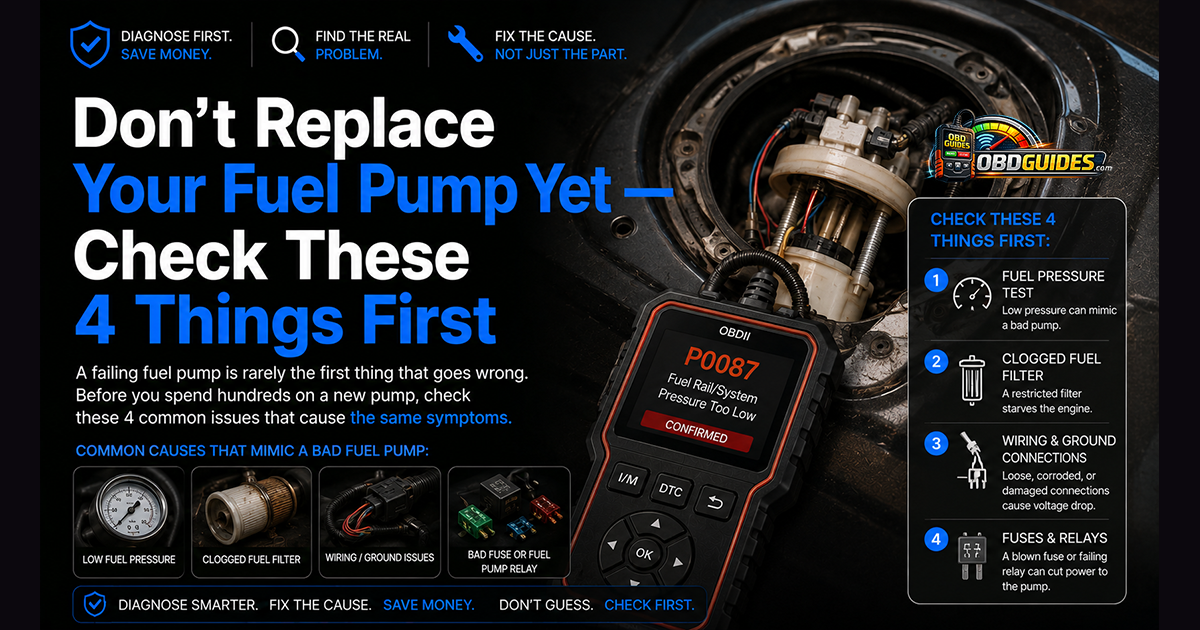
Don’t Replace Your Fuel Pump Yet — Check These 4 Things First
Your car won’t start, cranks but doesn’t fire, or dies at highway speed, and someone told you the fuel pump is dead. Before spending $300–$800 on a fuel pump and several hours of labour to drop the fuel tank, check these four things. Any one of them can cause identical symptoms — and each one costs almost nothing to check or fix.
1Inertia / fuel cutoff switch$0 — reset
2Fuel pump relay$5–$15
3Fuel filter (external)$15–$30
4Pump ground wire and fuse$0–$10
4 Checks Cost
$0–$55
Fuel Pump Replacement
$300–$800
Complete all 4 checks in under 30 minutes before ordering a pump
These Symptoms Point to the Fuel System — But Not Always the Pump
The symptoms below are commonly attributed to a failed fuel pump — but every single one of them can be caused by a failed relay, a tripped inertia switch, a clogged filter, or a bad ground wire. Before any money changes hands, the 4-point check in the next section rules out all of these for under $55.
🔑
Engine cranks but won’t start — no fuel smell
The starter is working, the engine turns over, but it never fires. No fuel smell from the exhaust. This classic “cranks no start” symptom is often attributed to a dead pump — but a tripped inertia switch, failed relay, blown fuse, or bad pump ground produces identical behaviour. Check these first before assuming the pump has failed.
Also check: spark (coil, plugs) · compression — fuel isn’t always the cause of crank-no-start
💀
Car dies suddenly at highway speed and won’t restart
Running normally then cuts out completely at speed — as if the key was turned off. This is one of the most alarming fuel pump symptoms but is also exactly what a failed relay, blown fuse, or a pump that overheated due to a clogged filter produces. Check the relay first — swap it with an identical relay from another circuit in the fuse box and attempt a restart.
Loses power under load — fine at idle, struggles at speed
Engine runs normally at idle and low speeds but hesitates, bogs, or loses power under hard acceleration or at highway speed. The fuel system can keep up at low demand but can’t deliver adequate pressure under load. A severely clogged fuel filter is the most common cause of this load-dependent power loss — and a filter is $15–$30. See our guide on losing power uphill.
Most likely cause: clogged fuel filter · replace before diagnosing the pump
🔄
Hard to start when hot — starts fine when cold
Engine starts easily when cold but requires extended cranking or won’t start when hot (after sitting for 20–30 minutes after a drive). A pump that works when cold but loses voltage under heat can indicate a failing relay whose internal resistance increases with temperature, or a pump ground wire with corrosion that worsens as the metal expands with heat. Check the relay and ground connection before condemning the pump.
Temperature-related: relay, ground wire, or pump check valve failing
🔊
No fuel pump prime sound when key is turned to ON
On most vehicles, turning the key to the ON position (not START) triggers a 2–3 second fuel pump prime cycle — a faint whirring sound from the fuel tank area. If this sound is absent, the pump is not receiving power. Check the relay and fuse before assuming the pump motor has failed — no prime sound is equally consistent with a failed relay or blown fuse as with a dead pump motor.
Test: turn key to ON, listen at fuel filler cap for prime hum
// 02 — The 4 Checks — In Order
Do These 4 Checks Before Ordering a Fuel Pump
Complete these in sequence — each one takes under 10 minutes and the total cost is $0–$55. Any one of them being the cause saves $300–$800 in pump replacement cost plus the labour of dropping the fuel tank.
1
Inertia / Fuel Cutoff Switch — Reset for Free
$0 — Free Reset
Ford vehicles (F-150, Explorer, Mustang, Focus, Fiesta, and most other Ford models) are equipped with an inertia switch — a safety device designed to cut fuel pump power in the event of a collision. This switch trips on significant impacts and occasionally on rough roads or hard bumps. When it trips, the fuel pump receives no power — the engine cranks but won’t start, with no fuel pump prime sound. It is indistinguishable from a dead fuel pump without knowing to check the switch.
Location varies by model but is most commonly in the passenger footwell (under the dash, passenger side), in the boot/trunk area, or behind a kick panel. It is a small cylindrical or rectangular button, typically with a red or white reset button on top. To reset: press the button firmly until it clicks. Attempt to start. If it was tripped, the engine starts immediately.
Some GM, Toyota, and European vehicles have similar fuel cutoff or inertia safety switches — check your owner’s manual under “fuel system” or “safety switches” before assuming the pump has failed.
Applies to
Ford vehicles — most models 1990+. Some GM and others.
How to find it
Owner’s manual → index → “inertia switch” or “fuel shutoff”
Fix
Press reset button until it clicks. $0. Takes 30 seconds.
2
Fuel Pump Relay — Swap Test
$5–$15 if failed
The fuel pump relay controls the electrical supply to the fuel pump motor. A failed relay cuts power to the pump — the pump motor itself may be perfectly functional but receives no electricity. A failed relay is far more common than a failed pump motor and costs $5–$15 to replace.
How to test it: Open the fuse/relay box (under the bonnet or in the cabin — location shown on the cover). Find the fuel pump relay — it will be labelled in the fuse box diagram on the cover or in the owner’s manual. Locate an identical relay in the same fuse box (look for the same part number stamped on the relay body — horn relay, fan relay, or A/C relay often use the same relay). Swap the fuel pump relay with this identical relay. Attempt to start the vehicle. If it starts — the original relay was faulty. Replace it for $5–$15.
While the relay box is open, also check the fuel pump fuse — it should show continuity on a multimeter and a visual inspection shouldn’t show a broken element. A blown fuse is a $1 fix.
Applies to
All vehicles with a fuel pump relay (virtually all modern vehicles)
Test method
Swap with identical relay from same fuse box — attempt to start
Fix cost
$5–$15 relay · $1 fuse
3
Fuel Filter (External) — Replace if Over 30,000 Miles
$15–$30
Many vehicles have an external fuel filter in the fuel line (under the vehicle or in the engine bay) that should be replaced every 30,000 miles. A severely clogged filter restricts fuel flow so significantly that the pump cannot deliver adequate pressure — particularly under load. The symptoms are identical to a failing pump: loss of power under hard acceleration, hesitation at highway speed, and difficulty starting when fuel demand is high.
A clogged filter also kills pumps prematurely. The pump works against the restricted filter, drawing more current and generating more heat than designed. This shortens pump life significantly. If the filter hasn’t been replaced in 30,000+ miles, replace it before diagnosing the pump — it may resolve the power loss symptoms and protect the pump from further damage.
Note: Many vehicles from approximately 2005 onwards moved to an in-tank filter integrated with the fuel pump module — these vehicles don’t have a separately serviceable external filter. Check your owner’s manual or a parts catalogue search for your vehicle to confirm whether an external filter exists before looking for it.
Applies to
Vehicles with external inline fuel filter — most pre-2005 and some newer models
Service interval
Every 30,000 miles or every 2–3 years
Fix cost
$15–$30 filter · 15–20 min DIY
4
Fuel Pump Ground Wire and Power Supply
$0–$10
The fuel pump ground wire runs from the pump to the vehicle’s chassis. Corrosion, a loose connection, or a frayed ground wire creates resistance in the circuit — the pump receives insufficient voltage to operate properly. A pump running at 9V instead of 12V delivers significantly less pressure than designed, causing the same symptoms as a weak or failing pump: low pressure under load, difficulty starting when hot, and intermittent no-starts.
How to test it: With the key in the ON position (not START), use a multimeter to measure voltage directly at the fuel pump connector in the tank area (you may need to access it under the rear seat or in the boot/trunk). The pump should see 12–14V when the relay is active. Less than 11V indicates a voltage drop from a bad ground or corroded power supply wire. Cleaning or replacing the ground connection costs nothing if it’s just corrosion — a jumper wire test (running a temporary ground wire from the pump body to a known good chassis ground) confirms a ground fault immediately.
Also inspect the wiring harness for the pump for signs of heat damage, rodent chewing, or chafing where the harness routes near hot exhaust components or sharp edges.
Test tool
Multimeter · measure voltage at pump connector with key ON
Healthy reading
12–14V at pump connector · below 11V = voltage drop fault
Fix cost
$0 to clean · $5–$10 for new ground wire
// 03 — If All 4 Checks Pass — Test Fuel Pressure
How to Confirm the Pump Has Failed — Fuel Pressure Test
If the inertia switch is fine, the relay swapped fine and doesn’t fix the problem, the filter has been replaced, and the ground voltage is healthy — the next step is a fuel pressure test. This confirms whether the pump is actually delivering adequate pressure before committing to replacement.
A fuel pressure gauge connects to the Schrader valve on the fuel rail (the same type as a tyre valve stem — most vehicles have one accessible in the engine bay). Readings taken at idle, at snap throttle, and with the key ON but engine off (static pressure) reveal exactly what the pump is delivering.
Fuel Pressure Reference — Port-Injected Petrol Engines
Values vary by vehicle — always verify against your specific manufacturer’s specification
55–65 PSI
Healthy — Most Modern Port-Injected Engines
Fuel rail pressure at idle with vacuum line connected. Pressure should hold steady and not drop more than 5 PSI in 5 minutes with key off (pressure hold test). Snap throttle should briefly spike pressure slightly higher.
35–45 PSI
Healthy — Older Return-Style Systems (pre-2000)
Older return-line fuel systems run at lower pressure. Consult the vehicle’s factory specification — this range covers many pre-2000 naturally aspirated petrol engines.
Below spec at idle
Possible Clogged Filter, Weak Pump, or Leaking Pressure Regulator
Low pressure at idle can be a clogged filter (if not yet replaced), a failing pump, or a leaking fuel pressure regulator. If the filter has just been replaced and pressure is still low, the pump is likely failing.
Drops significantly under snap throttle
Weak Pump — Cannot Meet Demand Under Load
Pressure drops 10+ PSI under snap throttle (simulating high demand). This is a pump that can maintain pressure at idle but cannot keep up under demand — matches the “fine at idle, loses power at speed” symptom pattern. Pump replacement confirmed.
No pressure / zero PSI
No Fuel Delivery — Pump, Relay, Fuse, or Inertia Switch
Zero pressure means no fuel is reaching the rail. Confirm relay, fuse, and inertia switch are all functioning before concluding the pump motor has failed. Zero pressure with all electrical checks confirmed good = pump replacement required.
Pressure drops rapidly with key off
Leaking Fuel Injector, Pressure Regulator, or Check Valve
If pressure drops more than 5–10 PSI within 5 minutes of key off, the system isn’t holding pressure. This causes hot-restart difficulty. Often a leaking injector or failed check valve in the pump — not necessarily a fully failed pump. Diagnose before replacing.
// 04 — Replace the Pump or Not?
Fuel Pump — Replace or Check Further?
Engine cranks but won’t start on a Ford, Mercury, or Lincoln — check the inertia switch first. Takes 30 seconds. Many mechanics miss this and go straight to pump diagnosis.
Car died suddenly and won’t restart — swap the fuel pump relay with an identical relay from the same fuse box before doing anything else.
Loss of power under load, fine at idle — replace the external fuel filter if it hasn’t been done in 30,000 miles. This is $15–$30 and is the most common cause of this specific symptom pattern.
No fuel pump prime sound when key is turned to ON — verify relay and fuse before concluding the pump is dead. Also check voltage at the pump connector with key ON.
Hard to start when hot — test voltage at the pump connector when hot (key ON, hot engine, not running). Below 11V confirms a voltage/ground fault. Also swap the relay when hot as some relays pass cold but fail hot.
All 4 checks confirmed good, fuel pressure gauge shows pressure below manufacturer spec at idle, drops significantly under snap throttle, or reads zero with all electrical checks passing — pump replacement is confirmed.
Fuel pressure is zero and relay, fuse, inertia switch, and ground wire are all confirmed good — the pump motor has failed. Replacement required.
Fuel pressure holds at idle but drops rapidly (10+ PSI in under 5 minutes with key off, engine not running) and hot restarts are difficult — likely a failed check valve in the pump. Pump module replacement resolves this.
When pump replacement is confirmed — replace the filter at the same time. If the vehicle has an external fuel filter, always replace it simultaneously with the pump. A pump working against a clogged filter for 30,000+ miles has been under strain. Installing a new pump against the same old filter shortens the new pump’s life. The incremental cost of a filter alongside a pump replacement is $15–$30 and is always worth it.
If the pump failed on a low-fuel vehicle: Running the fuel tank consistently below a quarter tank accelerates pump wear. The fuel pump is submerged in fuel, which keeps it cool. Running low on fuel means the pump runs hot and dry — shortening its life significantly. After a pump replacement, keep the tank above a quarter full to extend pump life.
🤖
Still Not Starting After All 4 Checks?
Tell our free AI Diagnostic tool your make, model, the exact symptom (cranks but won’t start, dies at speed, loses power under load), and which checks you’ve already completed. It will identify the most likely remaining cause for your specific vehicle.
First confirm fuel delivery is the issue rather than spark or compression. Turn the key to ON (not START) and listen for the 2–3 second fuel pump prime hum from the tank area. No hum = no pump power — check relay, fuse, and inertia switch before the pump itself. If there is a prime hum but the car still won’t start, the fuel system may be delivering fuel — in which case check for spark (pull a plug wire and check for spark while cranking) and confirm the ignition system is functioning. A crank-no-start with fuel delivery and spark present points to timing, immobiliser, or compression issues.
Location varies by model and year. Most common locations: passenger footwell under the dash (behind the kick panel trim on the passenger side), in the boot/trunk behind a panel, or under the carpet. Check your owner’s manual under the index for “inertia switch” or “fuel shutoff switch” — Ford always documents this in the manual. If you don’t have the manual, search “[your Ford model year] inertia switch location” — the location is well documented for every model online. The switch typically has a red or white reset button on top.
In extreme cases yes — a filter so severely restricted that no fuel passes at all can prevent starting. More commonly, a very clogged filter causes a hard start (extended cranking before fire), power loss under load, and hesitation at highway speed, while allowing normal starting and idling. A filter that is 90% clogged may still allow the engine to idle but fail completely under the higher fuel demand of hard acceleration. Replace the external filter (where fitted) before diagnosing the pump — it costs $15–$30 and takes 20 minutes.
Most factory fuel pumps last 100,000–150,000 miles under normal conditions. Premature pump failure is most commonly caused by running the tank consistently below a quarter full (the pump runs hot without adequate fuel to cool it), a clogged fuel filter forcing the pump to work harder than designed, and contaminated fuel (rust, debris) entering the pump from a deteriorating fuel tank. Replacing the fuel filter on schedule (every 30,000 miles where an external filter exists) and keeping the tank above a quarter full are the two most effective ways to maximise pump life.
Yes, on most vehicles. In-tank fuel pumps are accessed by removing the rear seat cushion (on many sedans and SUVs) or by lowering the fuel tank. On vehicles with rear seat access, the job is 45–90 minutes. On vehicles requiring tank drop, it’s 2–4 hours and requires safely supporting the tank while disconnecting the lines — more involved but still a DIY-capable job for a mechanically confident owner. Key safety note: have the tank as empty as practical, work with ventilation, and have no ignition sources nearby. Disconnect the battery before starting. The fuel pump module typically includes the sender unit, strainer, and pump — replace the complete module, not just the pump motor.
// Know Someone About to Pay for a Fuel Pump? Share This First